
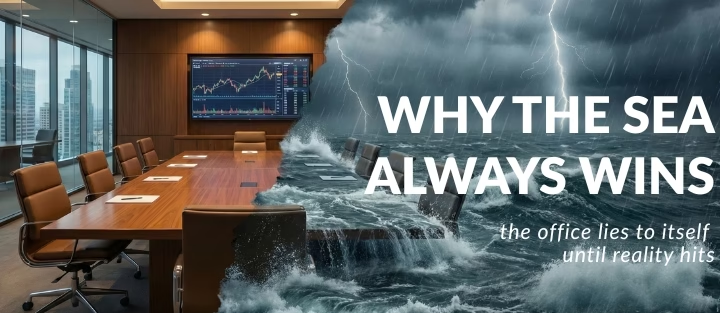
Why the Office Lies to Itself (and Why the Sea Always Wins)
(Article available on Linkedin)
Imagine a ship with perfect paperwork: every checklist ticked, every audit passed. The office pats itself on the back – zero incidents on record this year. Yet out at sea, that same ship is one error away from catastrophe. Why? Because the sea doesn’t read your checklists. It only tests what’s real. This is the paradox: on paper we’re safe, but in reality we’ve been lying to ourselves.
🎙️ Real Scene from the Field – When a Ship Capsized on a Calm Day
Brunswick, Georgia, 2019. A massive car carrier Golden Ray departs port on a clear morning. Minutes later, she begins to heel over, cargo tumbling. Within 40 minutes, the ship is on her side, half submerged. All 23 crew are scrambling for their lives; four are trapped in the engine room for 40 hours. What happened? Investigators discovered a stunning chain of complacency. The chief officer had mis-typed ballast data into a stability program, overestimating the ship’s stability. No one else double-checked his calculation – not the captain, not the office – because the safety management system (SMS) had no procedure for verifying stability. On top of that, two heavy watertight doors were left open for hours, and no one ensured they were shut before sailing. In the office report, the departure checklist was probably marked “complete” – in reality, the sea was about to roll an unstable ship onto its side.
In my audits, I’ve seen this pattern too often. Everyone trusts the paperwork. The departure report says stability OK, so we assume it’s true – until the ocean finds the hidden flaw. You can pass every audit and still be unsafe. The Golden Ray’s operator learned this the hard way: a $62 million ship lost because a simple truth was overlooked. The office believed its own narrative, but the sea always finds the truth.
🔍 Human Factor Insights – Normalized Deviance, Tick-Box Safety, Moral Distress
Why do smart, experienced people fall into these traps? Three human-factor culprits lurk beneath:
- Normalization of deviance: Small rule bends become routine when nothing bad happens immediately. Maybe it’s sailing with a bit less fuel reserve, or using a shortcut like leaving watertight doors open to “save time”. Over time, the unacceptable becomes acceptable. On Golden Ray, leaving those doors open had likely become “normal” – until it nearly killed the engineers. As one safety case put it, a minor shortcut can snowball into a dangerous practice if left unchecked We normalize deviance every day we treat a risky workaround as business-as-usual.
- Tick-box safety: This is the illusion that if a form is filled out, we’re covered. It’s safety by paperwork. In my SIRE 2.0 training sessions, this comes up constantly: officers admit they sometimes complete risk assessment forms after the job – just to have the paperwork done. The company SMS might have pages of procedures, but if they exist only to satisfy an auditor and not to guide operations, it’s tick-box safety. It breeds a false sense of security. We’ve all seen ships where the SMS manual sits untouched on the bridge, while the crew “gets the job done” by memory and habit. The office sees the documents and believes the ship is compliant; the crew knows those documents are often irrelevant on the real deck.
- Moral distress: Good people caught in bad systems. This is the human cost of the lie. It’s the junior officer who knows the correct action but feels pressured by the schedule or the boss to do otherwise. For example, a captain might know a storm route is too dangerous but also know the office won’t accept a delay – damned if you do, damned if you don’t. Moral distress is when mariners are forced to choose between “what’s right” and “what’s expected,” causing them deep angst. Over time, it erodes their trust in the system. They stop speaking up. They become cynical and disengaged – just doing as told, keeping their heads down. That’s deadly for safety. When crew stop voicing concerns because “why bother, nobody listens,” the organization loses its last early warning signals.
Together, these human factors create a culture where paper reality diverges from physical reality. The office sees green lights on a dashboard – compliance 100%, training 100%, incident-free days 365. Meanwhile on the ships, minor leaks, fatigued crew, corner-cutting practices are quietly accumulating risk. It’s only a matter of time before the gap is exposed by a near-miss or a disaster.
🧠 What This Means for SMS, SIRE 2.0, and Safety Audits
A Safety Management System is only as good as its execution. The ISM Code intended the SMS to bridge ship and shore, but in cases like El Faro it became just another binder on the shelf. The El Faro investigation revealed that the company had an SMS on paper yet failed to support the captain with what he needed – like real-time weather routing and hull maintenance. That weak safety culture left the crew ill-prepared for heavy weather and kept an aged, unseaworthy ship running until it met a hurricane. The lesson? An SMS isn’t a set-and-forget document; it must be a living, breathing practice. If your SMS says “crews must report safety concerns” but your culture shoots the messenger, your SMS has no teeth.
This is where SIRE 2.0 comes in with a wake-up call. Unlike old inspections that often focused on paperwork and finding equipment defects, SIRE 2.0 goes further – it interviews crew, probes their understanding, and zeroes in on human factors. An inspector might ask a random crew member how to enter an enclosed space safely, or how they handle fatigue. You can’t fudge that with a quick document fix; either the crew know it and do it, or they don’t. SIRE 2.0 explicitly recognizes that management systems alone won’t prevent accidents without real human engagement. I’ve sat through SIRE 2.0 trials – it becomes obvious which companies have been drilling real scenarios and which have just been “training to the test.” In one trial, a crew member honestly admitted he’d never seen the office’s fancy new safety app; the office had rolled it out as a “safety initiative” but failed to ensure it was practical onboard. That’s the kind of disconnect SIRE 2.0 is catching. It’s forcing offices to confront the reality on their vessels.
For safety audits in general, the implication is stark: we need to audit for reality, not for romance. It’s not about thick reports and spotless records; it’s about evidence that people on the ground (or on the water) truly understand and follow the spirit of the rules. This might mean more unannounced visits, more one-on-one talks with crew, more open-ended questions rather than yes/no checklists. It certainly means using audits to find deviance and distress, not to punish it but to fix it. An audit that finds zero findings is not necessarily a good audit – it might just mean problems were papered over. Remember, the goal is not to have a perfect audit; the goal is to have a safe ship. Sometimes that means embracing the ugly truths an audit or inspection reveals.
🩺 Diagnosis – The Real Systemic Dysfunction
At the heart of it, we’ve built a system that rewards looking safe over being safe. The office “lies to itself” not out of malice, but because the metrics and incentives push it to. Think about it: companies celebrate low incident rates, quick turnaround times, budget adherence. No one gets a bonus for saying “I found a serious safety risk and halted operations.” So officers learn to feed head office the reports it wants – smooth sailing, no problems. Bad news is buried or spun. Over time, management genuinely believes its fleet has no issues, because all they see are green KPIs. This positive reinforcement loop is lethal. It’s exactly how you end up with a ship that’s a rust bucket still scoring “satisfactory” on surveys, or crews formally certified as rested while in reality they’re exhausted.
The dysfunction is cultural and systemic: a lack of truth-telling. People on the frontlines often know where the cracks are – the ignored maintenance, the fudged log entries, the “near-misses” that were quietly swept under the rug – but they don’t feel safe to report it. They fear retribution or they believe nothing will change. Over time, those with integrity feel moral injury or leave, and what remains is a culture of silence and compliance theater. A perfect checklist can hide an imperfect culture, as one safety expert famously said. We see this in investigation after investigation. The NTSB report on Golden Ray bluntly noted the operator’s lack of oversight and auditing of stability calculations – essentially, the company wasn’t asking the right questions because it assumed the forms were being followed. The El Faro’s owner had a safety manual, but in practice they permitted a “weak safety culture” where a 40-year-old ship with outdated lifeboats and known issues kept sailing. Compliance created a dangerous complacency.
As a Critical Friend, I’ll put it plainly: this system lies. It lies through smiling reports and polished PowerPoints. It lies when we say “Safety First” but budget second. It lies when a junior engineer closes a temporary fix with tape and nobody questions it because the last inspection didn’t mention it. And every one of these lies will eventually be confronted by cold, hard reality. The sea has an unforgiving way of auditing our work – with waves, winds, and physics that couldn’t care less about our internal accolades.
🧭 Lesson – The Sea Doesn’t Care About Your Dashboards
Sooner or later, the sea always wins. This isn’t defeatist; it’s humbling. It means that nature doesn’t tolerate our pretenses. You can have the most beautiful safety dashboard showing “99.9% compliance” – the sea doesn’t care. It will exploit the 0.1% you ignored. If there’s a design flaw (remember the MOL Comfort breaking in half because of a hull weakness?), heavy weather will find it. If there’s a lapse in training, an emergency will expose it. If your culture encourages hush-hush over speak-up, eventually a calamity will shout the truth for you.
The sea doesn’t care about our arrogance; it respects only humility. Humility in this context means respecting the laws of physics and the limits of human performance. It means acknowledging that checklists and dashboards are tools, not shields. A quote from a Titanic retrospective rings true: “Humanity has always believed ‘this time we’ve conquered the sea.’ Yet the sea always wins.”. In maritime history, every boast of being unsinkable or infallible has been answered by saltwater in the engine room.
So, the lesson is philosophical: honesty is our only lifejacket. We must foster a culture where truth travels upward faster than comfort. Where a captain can say “this voyage isn’t safe” without fear. Where a Designated Person Ashore is not just a figurehead for certificates, but a trusted confidant for crew to share bad news. Where safety metrics include how often we find and fix problems, not just how good we look on paper. Because if we don’t find our problems, the ocean will find them for us – with far harsher consequences. In the end, it’s better to be honest and adaptive (humble to the sea’s power) than to cling to the pride of a perfect record right until it’s shattered.
The sea doesn’t care about dashboards, annual reports or reputations. It cares that your ship is fit and your people are prepared. Everything else is noise. And if the office can’t handle the signal through the noise, the sea will send an unmistakable message one day.
❓Your Stories from the Trenches
Now I turn it over to you – especially fellow DPAs, superintendents, captains, officers: Have you ever witnessed this gap between office fantasy and ship reality? What’s your story of when the sea exposed a truth that paperwork had hidden? Perhaps you’ve halted a voyage last-minute for safety, or you’ve fought an uphill battle to get shore management to listen to a concern. Or maybe you’ve seen a “near-miss” that never made it into any report but taught you a lesson you’ll never forget. Share it. We need these real stories. By speaking up and swapping lessons, we chip away at the illusion and get closer to genuine safety.
The floor is yours. In sharing our experiences – the good, bad, and ugly – we help ensure that our industry’s “office” learns to stop lying to itself. Let’s hear your truth from the frontlines. Your story might just save someone else’s ship.
