
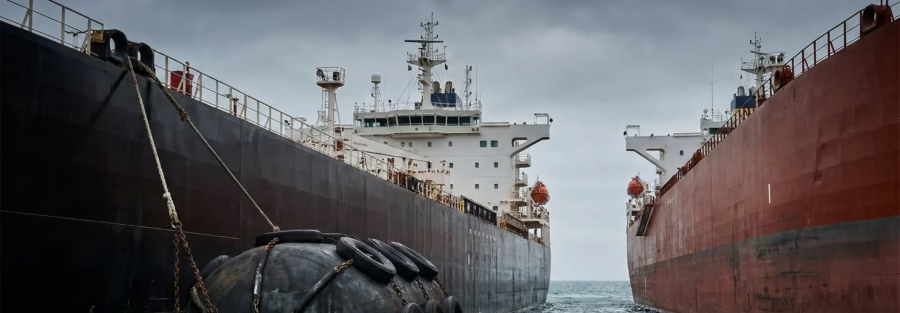
Why the 2025 STS Transfer Guide Redefines Risk, Responsibility, and Reality
From Niche Practice to a $1.9 Trillion Reality
The global Ship-to-Ship (STS) transfer market is no longer a marginal operational niche. It is projected to reach USD 1.9 trillion by 2032, driven by crude oil flows, chemical logistics, and the rapid expansion of LNG and LPG trades.
With that scale comes a hard truth:
STS operations have reached a tipping point. What once relied on experience, local practice, and “how we’ve always done it” is now expected to operate under globally harmonised, auditable, human-centred standards.
The release of the Ship to Ship Transfer Guide for Petroleum, Chemicals and Liquefied Gases – 2nd Edition (2025), developed by Oil Companies International Marine Forum in cooperation with CDI, ICS and SIGTTO, marks that moment.
It is a strategic reset of how STS risk is understood, managed, and judged.
Human error is not the exception. It is the dominant factor.
Decades of maritime accident investigations converge on one uncomfortable statistic:
Between 70% and 96% of maritime incidents are linked to human error.
The 2025 STS Guide does something unprecedented for STS standards:
➡️ It places Human Factors at the centre of operational safety, not as an appendix or training note, but as a core design principle.
From “preventing mistakes” to managing performance
Earlier STS guidance focused primarily on:
- equipment integrity,
- mooring geometry,
- hose specifications,
- weather limits.
All essential. But insufficient.
The new edition recognises that STS operations are cognitively and psychologically demanding events, requiring:
- sustained attention,
- precise communication between two bridges,
- judgement under commercial pressure,
- fatigue management during long, high-stress evolutions.
Instead of assuming perfect humans following perfect procedures, the Guide adopts an anthropocentric model:
Design the operation around real human capabilities and limitations.
HFACS enters STS operations
For the first time, the Guide aligns its thinking with the Human Factor Analysis and Classification System (HFACS) framework.
This matters because HFACS reframes incidents across four layers:
- Unsafe acts (misjudged distances, delayed abort decisions, skipped checks)
- Preconditions for unsafe acts (fatigue, stress, degraded situational awareness, poor bridge climate)
- Unsafe supervision (commercial pressure, inadequate briefings, tolerance of shortcuts)
- Organisational influences (SMS design, training philosophy, resourcing decisions)
In practical terms, the Guide now expects operators to address:
- soft skills (communication, assertiveness, challenge culture),
- mental wellbeing and resilience, especially in prolonged STS windows,
- fatigue as a system risk, not a personal failure.
This aligns directly with how SIRE 2.0 inspectors assess performance, not paperwork.
Operational and Technical Updates That Actually Matter
Words shape behaviour — CHS and MS replace “Mother/Daughter”
One of the most visible changes is the replacement of legacy terminology:
❌ Mother Ship / Daughter Ship
✅ Constant Heading Ship (CHS)
✅ Manoeuvring Ship (MS))
This is more than political correctness or linguistic hygiene.
It removes size-based and hierarchical assumptions and replaces them with functional clarity:
- CHS — the vessel maintaining course and speed stability
- MS — the vessel actively controlling the approach and alignment
In real STS incidents, ambiguity over “who is responsible for what” has repeatedly delayed abort decisions. The new terminology anchors responsibility in physics, not perception.
Alignment with inspection and environmental regimes
The Guide explicitly harmonises STS practice with:
- SIRE 2.0, focusing on Performance Influencing Factors (PIFs),
- MARPOL Annex I, especially STS planning obligations.
This means STS is no longer evaluated only during the operation itself, but through:
- SMS design,
- crew preparation,
- fatigue controls,
- decision-making logic.
STS has become inspectable as a system, not just as an event.
From Guidance to Execution — Key OCIMF Operational Tools
What makes the 2nd Edition STS Guide (2025) particularly relevant is that it does not stand alone. It is designed to work in direct conjunction with OCIMF operational tools that translate principles into execution.
Three documents are especially critical:
1. Ship-to-Ship Safety Checklist
The revised STS philosophy is operationalised through the OCIMF STS Safety Checklist, which now functions not merely as a “tick-box” exercise, but as a joint risk alignment tool between vessels.
👉 Official OCIMF link: https://www.ocimf.org/es/document-libary/ship-to-ship-safety-checklist
This checklist:
- reinforces shared situational awareness,
- forces explicit confirmation of readiness on both bridges,
- aligns directly with SIRE 2.0 performance-based assessment, not paperwork compliance.
2. Crane Plan — Transfer of Personnel Between Vessels
One of the most sensitive evolutions in STS operations is personnel transfer at sea.
The 2025 Guide clearly elevates this activity to a high-risk operation requiring formal planning, fully aligned with the OCIMF Crane Plan standard.
👉 Official OCIMF link: https://www.ocimf.org/es/document-libary/crane-plan%E2%80%93transfer-of-personnel-by-crane-between-vessels
This document mandates:
- a risk-based crane plan,
- defined environmental limits,
- competence verification,
- explicit go / no-go criteria.
From a DPA and insurer perspective, this is no longer optional — it is expected evidence of due diligence.
3. LNG STS Compatibility Questionnaire
With the rapid expansion of LNG STS operations, compatibility is no longer assumed — it must be demonstrated.
The Guide explicitly references the LNG STS Compatibility Questionnaire as a core pre-operation verification tool.
👉 Official OCIMF link: https://www.ocimf.org/es/document-libary/liquefied-natural-gas-sts-compatibility-questionnaire
This questionnaire addresses:
- ESD and ERC compatibility,
- cargo and vapour handling interfaces,
- communication and control philosophy,
- operational limitations specific to cryogenic cargoes.
In practice, this document is becoming a commercial gatekeeper for LNG STS approvals.
Why These Links Matter
Together, these OCIMF tools show the real intent of the 2025 STS Guide:
Safety is no longer proven by experience alone — it is proven by structured preparation, shared understanding, and human-centred execution.
For operators, Masters, Superintendents and DPAs, these documents are now part of the minimum credible STS operating standard, not best practice.
Why This Guide Is a Business Necessity, Not a Technical Option
In the era of energy transition, STS operations are expanding into:
- LNG and LPG offshore transfers,
- complex multi-cargo interfaces,
- higher environmental and reputational exposure.
Against that backdrop, the 2025 STS Guide functions as:
- A compliance shield Demonstrating alignment with MARPOL and SIRE 2.0 expectations.
- An insurance filter Underwriters increasingly scrutinise human-factor controls after incidents.
- A reputational firewall In a world of instant AIS scrutiny and sanction exposure, “procedurally correct but practically unsafe” is no longer defensible.
Most importantly, it is a strategic risk-management tool:
Organisations that treat STS as a purely technical exercise will struggle. Those that integrate human performance into their STS philosophy will endure.
What SIRE 2.0 Inspectors Will Really Look For During STS Operations
Under SIRE 2.0, STS inspections are no longer about proving that procedures exist. They are about proving that people can execute them under pressure.
Based on the philosophy embedded in the 2025 STS Guide, inspectors will focus on Performance Influencing Factors (PIFs) rather than documentation aesthetics.
1. How decisions are made — not just what the procedure says
Inspectors will explore:
- how the Master and bridge team define abort criteria,
- whether go / no-go decisions are explicit, shared and rehearsed,
- how commercial pressure is handled when conditions deteriorate.
A perfect STS plan is meaningless if the crew cannot explain when and why they would stop the operation.
2. Quality of communication between CHS and MS
With the introduction of CHS / MS terminology, inspectors will assess:
- clarity of role allocation during approach and mooring,
- use of standardised phraseology,
- bridge-to-bridge communication discipline,
Silence, hesitation, or ambiguous language is now seen as a risk signal, not a cultural preference.
3. Fatigue awareness and workload management
STS operations are long, demanding and mentally exhausting.
Expect inspectors to ask:
- how fatigue was assessed before the operation,
- how watch rotations were managed,
- whether key decision-makers were rested or already cognitively depleted.
Fatigue is treated as a system design issue, not an individual weakness.
4. Evidence of Human Factors integration in the SMS
Inspectors will look for practical signs that Human Factors are embedded, such as:
- STS-specific risk assessments addressing human performance,
- training that goes beyond technical competence,
- lessons learned from previous STS operations and near-misses.
What matters is not the number of procedures — but whether the SMS helps people think clearly when it matters most.
5. Use of OCIMF tools as living documents
The following are no longer viewed as static forms:
- STS Safety Checklist,
- Crane Plan for personnel transfer,
- LNG STS Compatibility Questionnaire.
Inspectors will assess how these tools were used:
- Were they discussed jointly?
- Were risks challenged?
- Were assumptions tested?
Ticked boxes without dialogue are increasingly seen as paper safety.
The Unspoken SIRE 2.0 Reality
SIRE 2.0 inspectors are trained to detect one thing above all:
Does this crew understand the operation — or are they merely complying with it?
The 2025 STS Guide aligns perfectly with that mindset.
Operators who treat STS as a technical checklist may still pass inspections — but those who demonstrate human-centred operational thinking will build lasting trust with charterers, insurers and regulators.
The 2nd Edition STS Guide quietly delivers a powerful message:
Steel does not fail first. People do — when systems are designed as if they never would.
The industry now has a framework that acknowledges this reality.
The question is no longer whether to adopt it — but how honestly organisations are willing to implement it.
What do you see as the weakest link in STS operations today — equipment, procedures, or the way we prepare people to make decisions under pressure?
