
Why Behavioral Assessment Was Introduced in Maritime Audits
(Article available on Linkedin)
(And why a navigational audit is incomplete without it)
A ship can be fully compliant. And still be unsafe.
This is not a paradox. It is the daily reality of maritime audits.
For years, audits focused on what could be seen, measured, and verified: procedures, checklists, certificates, logbooks.
And accidents… kept happening.
That is why behavioral assessment is no longer a “nice-to-have”. It has become a critical element of modern audits, including navigational audits.
Where did behavioral assessment come from?
The answer is uncomfortable:
Because accident investigations repeatedly showed that the absence of procedures is rarely the cause. Much more often, it is the way people actually work.
MAIB, NTSB, ATSB, BSU and similar investigation bodies have been telling the same story for years:
- procedures were in place,
- equipment was operational,
- training had been “completed”,
yet:
- no one challenged the Master’s decision,
- no one stopped a developing unsafe manoeuvre,
- no one said: “This does not look right.”
These are not technical failures. They are behavioral failures.
What is behavioral assessment from a psychological perspective?
Behavioral assessment in audits is the systematic observation and interpretation of human behavior in an operational context.
It is not about:
- judging personality,
- deciding whether someone is a “good officer”,
- reading minds.
It is about understanding psychological mechanisms, such as:
🧠 1. Authority and hierarchy
Do officers:
- challenge decisions?
- ask questions?
- voice concerns?
Or do they remain silent once the Master has “decided”?
🧠 2. Normalization of deviation
Are unsafe practices:
- treated as exceptions,
- or accepted as “the way we do it here”?
🧠 3. Situational awareness
Does the bridge team:
- build a shared mental model of the situation,
- or operate in individual silos?
🧠 4. Fatigue and cognitive load
Does the crew:
- recognize degraded performance,
- or pretend that “everything is fine” because the system expects it?
Why traditional audits fail to detect this
Because procedures do not reveal behavior.
In a navigational audit, it is relatively easy to verify:
- correct ECDIS configuration,
- completeness of the passage plan,
- formal implementation of Bridge Resource Management.
It is far more difficult to see:
- whether the OOW feels empowered to stop a manoeuvre,
- whether the Master actively invites challenge and discussion,
- whether BRM exists in spoken communication, not just in manuals.
Checklists are binary. Humans are not.
Navigational audits as the perfect example
During navigational audits, behavioral assessment often reveals issues that no document can capture, for example:
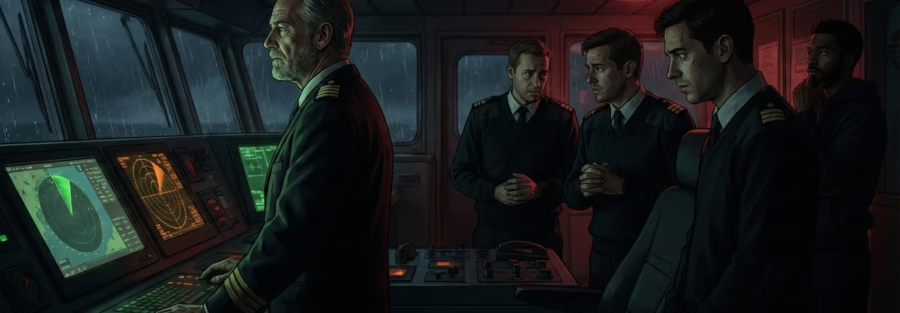
- The Master conducts navigation but does not verbalize intentions. The team is left to guess.
- The OOW notices a deviation from the passage plan but thinks: “The Master knows what he’s doing.”
- The Pilot is treated as an unquestionable authority instead of a team member.
- The bridge is silent. Not because everything is under control. But because no one wants to be the person who creates a problem.
These are signals of safety culture. And this is precisely what behavioral assessment is meant to identify.
Why this matters today (SIRE 2.0, vetting, SMS)
Because the industry has finally acknowledged that:
Human error is not a cause. It is an outcome of systems, culture, and behavior.
SIRE 2.0 clearly shifts the focus:
- from “Does the procedure exist?”
- to “Is it understood, applied, and supported by human behavior?”
Behavioral assessment:
- provides context for auditors,
- offers operators a realistic picture of risk,
- gives crews a chance for dialogue, not just evaluation.
Diagnosis
If behavioral assessment is:
- superficial,
- reduced to polite conversation,
- treated as a formality,
then it adds little value.
But when conducted by an auditor who:
- understands psychology,
- knows bridge operations,
- can observe, listen, and ask the right questions,
it becomes the most valuable part of the audit.
Final lesson
Procedures describe how things should work. Behavior shows how they actually work.
Ships do not run aground because of procedures. They run aground because of human decisions made in real time.
❓ A question for you
In your audits, is behavioral assessment:
- a genuine diagnostic tool,
- or just another word in the report?
