
Turning the SOLAS PFOS Ban into Your Commercial Advantage
The January 2026 Deadline is Closer Than You Think
The maritime industry operates in a high-stakes environment where regulatory scrutiny is intensifying globally. A single month-long operation by INTERPOL, “Operation 30 Days at Sea 3.0,” recently uncovered a staggering 1,600 marine pollution offences worldwide. This stark statistic serves as a powerful reminder that compliance is not a passive, bureaucratic exercise but a critical component of risk management in an era of heightened environmental accountability.
The Escalating Challenge of PFOS Compliance
The impending SOLAS amendment presents a multifaceted challenge that extends far beyond simple equipment replacement. It demands a thorough understanding of the new regulatory landscape, a shift away from outdated compliance philosophies, and a clear-eyed assessment of the severe commercial consequences of failure.
The New Regulatory Landscape: What SOLAS and the IMO Require for PFOS
The technical requirements for the PFOS prohibition are precise and non-negotiable. As of January 1, 2026, any fire-extinguishing media on ships engaged in international voyages found to contain PFOS in concentrations exceeding 10 mg/kg (0.001% by weight) will constitute a violation of SOLAS.
Verification of compliance is an active, not a passive, requirement. Operators cannot simply assume their foam is compliant; they must be able to prove it with specific documentation kept on board. As detailed in MSC.1/Circ.1694, there are three acceptable methods for demonstrating compliance:
- Maker’s Declaration: A formal document issued by the foam manufacturer that includes essential details such as the foam type, production period, batch number, and reference to its type approval or MED Certificate.
- Laboratory Test Reports: An official analysis from a qualified laboratory confirming that the PFOS concentration in the foam is below the regulatory threshold.
- Onboard Sampling and Testing: In cases where a maker’s declaration or lab report is not available—a common issue for older foam stocks—the extinguishing media on board must be sampled and tested. This testing must be conducted by a laboratory accredited in accordance with ISO 17025 or an equivalent standard, adding a significant layer of logistical complexity and cost.
The IMO has established distinct timelines for new and existing vessels, which necessitates careful fleet-wide planning to manage the rolling deadlines. New ships constructed on or after January 1, 2026, must have their compliance confirmed during the initial Classification Survey during Construction. For the existing fleet, compliance must be verified at the first Safety Equipment Survey conducted on or after January 1, 2026.
The following table provides a quick-reference guide to these critical requirements.
| Vessel Category | Key Date/Timeline | Verification Method | Survey Type for Confirmation | Key Action Required |
|---|---|---|---|---|
| New Ships | Constructed on/after 1 Jan 2026 | Maker’s Declaration or Lab Report | Classification Survey during Construction | Ensure compliant media is specified and documented at the build stage. |
| Existing Ships | First Safety Equipment Survey on/after 1 Jan 2026 | Declaration, Report, or Onboard Sampling/Testing | Safety Equipment Survey | Prioritize fleet inventory and documentation retrieval immediately. |
| All Ships (Media Replacement) | On/after 1 Jan 2026 | Maker’s Declaration or Lab Report | Periodical Classification Survey | Update procurement and maintenance procedures to ensure only compliant foam is supplied. |
The regulation targeting PFOS exists for a compelling reason. PFOS is a type of per- and polyfluoroalkyl substance (PFAS), a class of synthetic chemicals infamous for their extreme environmental persistence. Termed “forever chemicals,” they do not readily break down in nature. Instead, they accumulate in organisms and magnify up the food chain, posing a long-term threat to marine ecosystems and potentially to human health through the consumption of contaminated seafood.
The real-world consequences of a large-scale release were starkly illustrated by the Galveston Bay incident in 2019. Following a major petrochemical fire, the extensive use of Aqueous Film-Forming Foam (AFFF), a PFOS-containing agent, resulted in PFOS concentrations in the bay’s surface waters surging to levels up to 300 times higher than baseline measurements. This contamination led directly to elevated PFOS body-burdens in local oysters and fish, prompting seafood consumption advisories and demonstrating how a single event can inflict immediate and lasting environmental damage.
This heightened environmental risk has fundamentally changed the nature of regulatory enforcement. Port State Control (PSC) inspectors are increasingly trained to look for systemic failures, not just isolated deficiencies. A container of non-compliant foam is no longer viewed as a minor equipment issue. It is now considered “objective evidence” of a potential failure in the implementation of the vessel’s Safety Management System (SMS) under the International Safety Management (ISM) Code. This shift in perspective is critical; the risk is not merely the presence of the prohibited substance, but what its presence implies about the operator’s overall safety and environmental management culture.
The True Cost of Non-Compliance: A Cascade of Commercial Failure
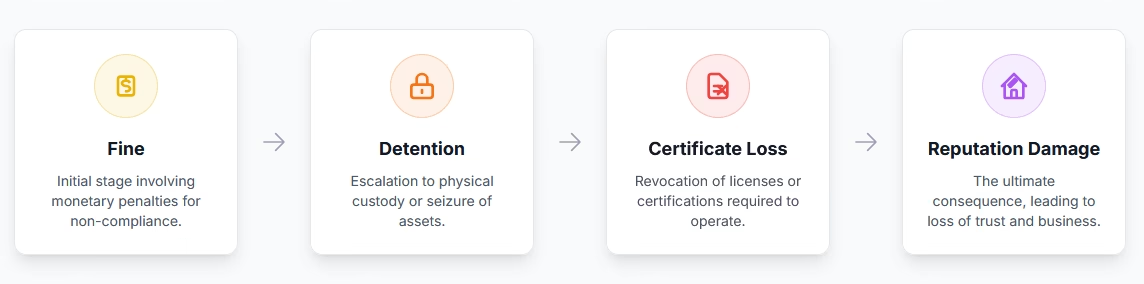
While administrative fines for environmental non-compliance can be significant, they represent only the initial financial impact. The true cost of failing to manage the PFOS transition is a cascade of operational, financial, and reputational damages that can cripple a company’s commercial viability.
This chain reaction begins with a single point of failure—a non-compliant foam concentrate discovered during a PSC inspection. This direct violation of SOLAS is magnified when the PSC officer, following established protocols, interprets it as a systemic failure of the ISM Code, thereby elevating the deficiency from a correctable issue to a detainable one. The immediate consequence is a port state detention, which instantly renders a valuable asset unproductive.
This detention triggers the most immediate financial hemorrhage: the vessel is declared “off-hire.” Under most time charter parties, an off-hire event means the charterer is no longer obligated to pay the daily hire rate, which can range from tens to hundreds of thousands of dollars per day. The shipowner loses 100% of their revenue from the vessel while continuing to bear 100% of the operational costs, including crew wages, insurance, port fees, and the expenses required to rectify the deficiency.
The damage, however, does not end when the vessel is released. A detention is a public mark on an operator’s record, eroding the company’s reputation among charterers, cargo owners, insurers, and financial institutions. This loss of trust has long-term commercial consequences, including increased insurance premiums, difficulty securing favorable charter agreements, and being placed on PSC target lists for more frequent and intensive future inspections. The initial investment required for proactive PFOS compliance is dwarfed by the cascading costs of this reactive failure.
Common Pitfalls: Where Good Intentions Go Wrong with PFOS Phase-Out
Navigating the PFOS transition requires more than good intentions. Many well-meaning companies will stumble into predictable traps that transform a manageable regulatory change into a significant commercial liability. Understanding these common pitfalls is the first step toward avoiding them.
Pitfall 1: The “Paper-Only” Compliance Trap
A frequent mistake is the belief that compliance can be achieved from a shore-side office. This “paper-only” approach involves updating the SMS manual, circulating a company-wide memo, and assuming the task is complete. The manual on the shelf may declare the fleet PFOS-free, but the reality on deck often tells a different story.
PSC inspectors are trained to expose precisely this gap between documentation and implementation. They will review the SMS and then conduct physical inspections and crew interviews to verify that the documented procedures are actually being followed. When a crew member is unaware of the new PFOS protocols, or when an old, undocumented foam canister is discovered in a locker, the “paper” compliance is rendered meaningless. This discrepancy is a classic indicator of an ineffective SMS, providing clear grounds for a detainable ISM deficiency. An operator’s policy stating all foam is PFOS-free is an unsubstantiated claim without a verified, vessel-by-vessel inventory supported by maker’s declarations or lab reports.
Pitfall 2: Overlooking the Human Factor in Preparation
Regulations are not implemented by paper; they are implemented by people. A fundamental and costly error is to treat the PFOS phase-out as a purely logistical or technical challenge while ignoring the human element. The success of any new safety procedure hinges entirely on the competence and commitment of the crew who must execute it.
This is not a theoretical concern. Extensive research into the implementation of maritime regulations consistently identifies insufficient personnel training and competency gaps as primary barriers to effective compliance. With studies indicating that human factors contribute to as many as 96% of maritime incidents, it is clear that the crew is the critical link in the safety chain. The crew must be able to physically identify non-compliant foam, understand the updated SMS procedures for handling and disposal, and know the correct emergency response for an accidental spill. Without training, the most perfectly written SMS and the most advanced inventory system are rendered ineffective by the person on deck who makes an uninformed decision. Investing in crew training is not a soft cost; it is a hard-nosed risk mitigation strategy.
Pitfall 3: Inconsistent Application Across the Fleet
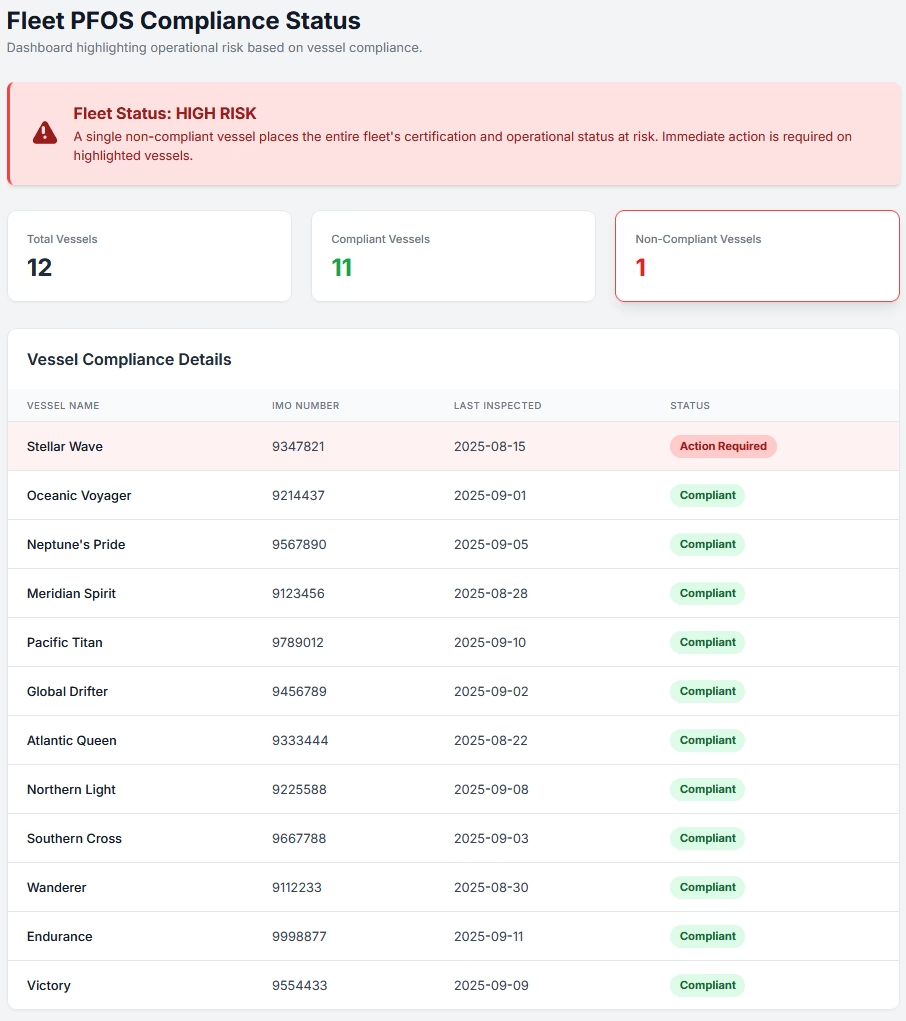
The third major pitfall is a fragmented, decentralized approach to implementation. In this scenario, a directive is issued from the head office, but the execution is left to the discretion of individual vessels. This inevitably leads to a patchwork of compliance levels across the fleet, creating a “weakest link” problem.
In today’s data-driven maritime industry, a single vessel’s failure reflects on the entire company. Charterers, insurers, and financiers use sophisticated risk assessment tools that analyze fleet-wide performance data. A detention of one ship for a PFOS-related deficiency signals a potential systemic weakness in the company’s management, elevating the perceived risk profile of all associated vessels. This can lead to more scrutiny and less favorable commercial terms for the entire fleet. The only effective way to mitigate this risk is through a centralized, top-down compliance program. This requires a comprehensive, fleet-wide inventory system that provides management with real-time, verifiable visibility into the compliance status of every fire-extinguishing system on every vessel. Anything less is a gamble with the company’s reputation.
The Proactive Blueprint for Success: A Step-by-Step Guide to PFOS Readiness
Avoiding the pitfalls of non-compliance requires a deliberate, systematic, and proactive approach. This three-step blueprint provides an actionable framework for transforming the PFOS mandate from a regulatory burden into a demonstration of operational excellence.
Step 1: Adopt a Fleet-Wide PFOS Inventory
- Create a single, company-wide database or tracking spreadsheet to serve as the master record for all foam concentrates across the fleet.
- Mandate a consistent data entry procedure for every foam container, capturing key information: Vessel Name, Onboard Location, Foam Type/Brand, Manufacturer, Batch Number, Date of Manufacture, Quantity, and, most critically, the status of its compliance documentation.
- Instruct ship staff to physically locate, inspect, and photograph every container, cross-referencing these physical assets with the vessel’s maintenance and supply records.
- For every identified foam batch, proactively locate the corresponding Maker’s Declaration or original Laboratory Test Report. This may involve contacting original equipment manufacturers, past suppliers, or the foam producers directly.
- For all items categorized as “non-compliance” a plan must be developed for onboard sampling and subsequent testing by an ISO 17025 accredited laboratory, timed efficiently with the vessel’s port call schedule.
- Foam that is confirmed to contain PFOS, either through documentation or by its manufacturing date/type (e.g., legacy AFFF). These items must be immediately quarantined and scheduled for disposal.
Step 2: Review Your SMS
- Review current SMS procedures for procurement, equipment maintenance, and hazardous waste management to identify where PFOS-specific controls and instructions are missing.
- Amend purchasing procedures to make a PFOS-free Maker’s Declaration a mandatory deliverable for any new fire-fighting foam.
- Update all relevant operational checklists, such as those for Safety Equipment Maintenance and Pre-PSC Inspection preparation, to include a specific line item requiring the verification of PFOS foam documentation.
Step 3: Empower Your Crew Through Targeted Training and Drills
- A concise, non-technical presentation of what PFOS is, the environmental reasons for the ban, and a clear statement of the company’s commitment to full compliance.
- Practical training using photographs to teach crew how to read container labels, identify legacy AFFF types, and understand the critical importance of the Maker’s Declaration.
- A step-by-step walkthrough of the updated SMS procedures for quarantine, system replacement, and, crucially, the safe landing of hazardous waste ashore.
- Reinforcement of emergency procedures for safely containing and managing a spill of PFOS foam concentrate, including the proper use of personal protective equipment (PPE) and spill kits.
From Reactive Firefighting to Proactive Resilience
The path to successful compliance with the SOLAS PFOS prohibition is built on a three-pronged strategy of proactive management. First, operators must achieve certainty through a forensic, fleet-wide inventory that replaces assumption with evidence. Second, they must embed compliance into their daily operations by fortifying the SMS with practical, real-world procedures. Finally, they must ensure execution by empowering their crews with targeted training and reinforcement through drills.
Ultimately, the SOLAS PFOS ban should be viewed as more than a regulatory hurdle; it is a litmus test for a company’s safety culture and commitment to operational excellence. By embracing this challenge proactively, operators are doing far more than avoiding detentions and fines. They are building a more resilient, efficient, and reputable business. This sends a clear and powerful signal to charterers, regulators, and the wider market that they are a top-tier operator committed to the highest standards of safety and environmental stewardship—a decisive competitive advantage in the modern maritime industry.
The January 2026 deadline leaves no room for uncertainty. Operators who are unsure about the compliance status of their fleet or who need to fortify their SMS against the coming changes are encouraged to seek expert guidance. A comprehensive Compliance Audit can identify risks and build a robust, cost-effective roadmap to ensure vessels are ready, resilient, and commercially advantaged.

