
“Silence on the Bridge” – Decision-Making Under Pressure at Sea – and Why Aviation Handles It Better
(Article available on Linkedin)
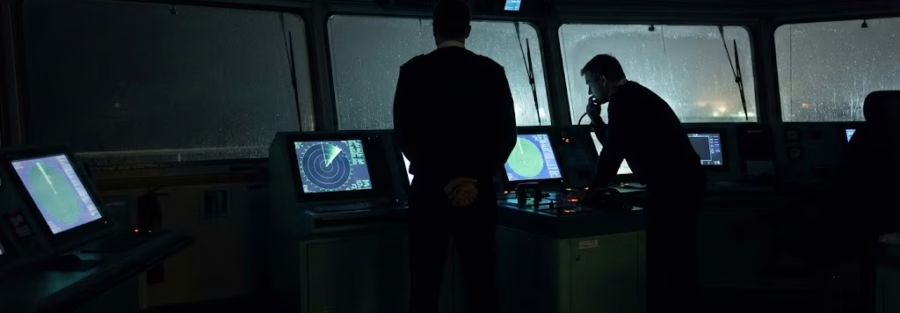
Bridge. Night watch. Routine conditions.
No alarms. No emergency. No raised voices.
Just light haze and a single contact on the radar.
The Officer of the Watch has been tracking it for several minutes. CPA looks acceptable. ECDIS appears clean. Speed is unchanged.
The Master is on the bridge. Standing quietly.
The OOW senses something is wrong. Not a number. Not an alarm.
A cognitive mismatch.
And in that moment—without a command, without discussion— a decision is made.
Not formally. Not procedurally.
Biologically.
Decision-Making Under Pressure Is Not Rational. It Is Physiological.
Under pressure, the human brain does one thing exceptionally well: it protects survival.
Neurophysiologically:
- cortisol and adrenaline increase
- prefrontal cortex activity is suppressed
- analytical capacity degrades
Control shifts from deliberate reasoning to automatic pattern recognition.
In decision science terms:
- System 2 (slow, analytical, effortful) disengages
- System 1 (fast, intuitive, habitual) takes over
This is not a weakness. It is how the human brain is designed.
At sea, however, it has a critical implication:
As pressure increases, authority and intuition dominate analysis.
Why the Maritime Environment Is Especially Hostile to Decision Quality
Unlike aviation or emergency medicine, maritime pressure is rarely acute and short-lived. It is chronic.
On the bridge, decision-making is continuously degraded by:
- cumulative fatigue and sleep debt
- motion-induced cognitive interruptions
- vibration and low-frequency noise
- isolation from external reference points
- strong hierarchical authority gradients
The result is not incompetence. It is functional cognitive narrowing.
Officers:
- perceive anomalies
- hesitate to escalate
- defer to authority
Not because they lack knowledge. But because the system discourages interruption.
Silence on the Bridge Is Not Calm. It Is a Warning Signal.
In many serious marine casualties:
- someone noticed the risk early
- someone felt uneasy
- someone almost spoke up
But:
- the situation was not yet “emergency-level”
- the Master appeared confident
- hierarchy remained intact
Silence is often misinterpreted as professionalism.
In reality, it frequently indicates decision-making paralysis at team level.
Aviation: A Different Assumption About Human Performance
In aviation, silence is not neutral. It is procedurally unsafe.
Flight crews are trained on a hard assumption:
Humans will freeze, tunnel, and misjudge under pressure.
Therefore, aviation systems are designed to:
- force verbalisation
- mandate challenge-and-response
- legitimise escalation against authority
- train startle and surprise explicitly
If something does not make sense:
- it must be verbalised
- it must be acknowledged
- it must be resolved
If the Captain does not respond:
- escalation is required
- authority can be overridden
Not because pilots are better people. But because the system expects human failure.
Maritime Reality: Still Built Around the “Hero Captain” Model
Many maritime SMS frameworks still implicitly rely on:
- experience as a primary safety barrier
- procedural compliance as proof of control
- authority as stabilising force
This creates a dangerous illusion.
Experience without correction mechanisms:
- reinforces confirmation bias
- normalises deviation
- suppresses dissent
The most dangerous maritime decisions are rarely chaotic.
They are:
- calm
- logical
- incremental
- and wrong
Case Study: Costa Concordia
When Silence, Authority, and Surprise Converge
The Costa Concordia disaster was not caused by lack of procedures. Nor by poor equipment. Nor by extreme environmental conditions.
It was a systemic decision-making failure under pressure.
Critical Moment 1: A Decision That Was Not Challenged
The “salute” manoeuvre was planned, not impulsive.
- proximity to shore was visible
- radar and ECDIS data were available
- bridge team was fully manned
Yet:
- no formal challenge occurred
- concerns were expressed indirectly
- authority remained unbroken
The first critical red flag appeared:
When everyone sees the risk, responsibility becomes diluted.
No one intervenes.
Critical Moment 2: Startle Response and Cognitive Freeze
Impact. Blackout. Rapid list.
This is where neurophysiology takes control.
The Master exhibited:
- disorientation
- difficulty integrating damage reports
- fixation on partial explanations
This was not denial by choice. It was cognitive overload and freeze.
In aviation, this phase is trained explicitly. In maritime operations, it often is not.
Critical Moment 3: Silence Instead of Escalation
Perhaps the most lethal element of the casualty was social, not technical.
- officers waited for direction
- engineers reported but did not escalate
- the general alarm was delayed for over an hour
Why?
Because the system had communicated one message clearly:
Decision authority rests with the Master alone.
When the Master froze, the system froze.
The Real Lesson from Costa Concordia
Do not ask: ❌ “Why did the Captain fail?”
Ask instead: ✅ “Why was the system unable to stop a failing decision?”
This was not an individual failure. It was a failure of decision architecture.
What a DPA Should Change After Costa Concordia
The Costa Concordia casualty was not a failure of seamanship. It was a failure of shore-side decision architecture.
If nothing changes ashore, the same mechanisms will reproduce themselves on another bridge.
1. Shift from “Procedure Compliance” to “Decision Interruptibility”
After Concordia, the critical question for a DPA is not:
“Are procedures in place?”
But:
“Can a wrong decision be interrupted in real time?”
Actionable change:
- Introduce explicit challenge authority in SMS
- Define situations where OOW or senior officers are required to escalate or override
- Treat failure to challenge as a safety deviation, not loyalty
If a system does not legitimise interruption, it silently prohibits it.
2. Redefine the Master’s Role in Crisis: From Authority to Facilitator
Concordia demonstrated the danger of cognitive isolation at the top.
Actionable change:
- Require the Master to verbalise decision logic during critical phases
- Embed the expectation that the Master actively invites dissent
- Include “cognitive openness under pressure” as a leadership competency in evaluations
A Master who does not externalise thinking becomes a single point of failure.
3. Introduce Non-Negotiable Decision Trigger Points
The most dangerous phase on Concordia was not the impact — it was the delay in declaring the emergency.
Actionable change:
- Define hard trigger thresholds (list, flooding, blackout duration, loss of propulsion)
- Link triggers to mandatory actions, not discretionary judgement
- Remove ambiguity that allows delay under reputational pressure
Trigger points protect people from their own denial.
4. Treat Silence as a Reportable Safety Condition
In Concordia, silence was misread as control.
Actionable change:
- Include communication dynamics in audits and inspections
- Train Masters and Officers to recognise silence as a degradation signal
- Capture “lack of challenge” as an observation, not a soft skill issue
Silence is not neutral. It is often the last visible sign before cognitive collapse.
5. Train for Startle, Not Just for Procedure
Concordia exposed a classic startle-and-freeze response.
Actionable change:
- Implement stress exposure training for Masters and bridge teams
- Use simulators to recreate confusion, noise, conflicting inputs, and time pressure
- Train recognition of freeze and methods to reset cognition
If startle is not trained, it will dominate the real event.
6. Reduce Authority Gradients by Design, Not by Intention
No SMS paragraph can override culture unless it is operationalised.
Actionable change:
- Standardise escalation language (e.g. mandatory phrases for challenge)
- Train multicultural crews explicitly on authority gradients
- Reinforce that safety escalation is a professional obligation, not insubordination
Culture does not change through statements. It changes through permission and repetition.
7. Accept the Core Truth Concordia Exposed
The most uncomfortable lesson for DPAs is this:
Even a competent, experienced Master can become cognitively unavailable under pressure.
Safety management must therefore assume:
- temporary leadership impairment is possible
- redundancy in decision-making is essential
- authority must be interruptible by design
If the system depends on one person always being right — it is already unsafe.
Final Note for DPAs
Costa Concordia was not a bridge problem. It was a shore problem manifesting offshore.
DPAs do not prevent accidents by writing better procedures.
They prevent them by ensuring that:
- the first wrong decision can be challenged
- the second one can be stopped
- and silence never goes unexamined
Because when the bridge goes quiet, the system is already speaking.
Decision-Making Red Flags on the Bridge
A Practical Checklist for Masters, DPAs, Fleet Managers, and Auditors
This checklist does not focus on procedures. It focuses on early indicators that decision quality is degrading.
🚩 1. Silence During Critical Phases
- minimal questioning
- absence of verbal challenge
- lack of closed-loop communication
Silence ≠ control Silence = potential cognitive freeze
🚩 2. Single-Narrative Dominance
- one person interprets all information
- alternative assessments are not voiced
- dissent is implicitly discouraged
A single cognitive model means zero redundancy.
🚩 3. Intuition Without Structured Verification
- “It feels right”
- “We’ve done this before”
- “We should be fine”
Under pressure, intuition is the least reliable safety barrier.
🚩 4. No Defined Trigger Points
- no pre-agreed thresholds for action
- decisions repeatedly postponed
- alarms treated as reputational events
Absence of triggers enables denial.
🚩 5. Hierarchy Overrides Situation Awareness
- officers hesitate to interrupt
- warnings are softened
- authority is preserved at all costs
Without the right to challenge, BRM is cosmetic.
🚩 6. Cognitive Isolation of the Master
- decisions not verbalised
- poor delegation
- internalised reasoning
A cognitively isolated Master is a single-point failure.
🚩 7. No Training for Surprise and Freeze
- procedures known only in calm conditions
- no stress-exposure training
- no recognition of startle response
A procedure that cannot be executed under stress does not exist.
Implications for Safety Management and Leadership
If during an audit:
- documentation is flawless
- procedures are immaculate
- the bridge team is quiet and compliant
This is not proof of safety.
It may be an early warning.
The sea does not test paperwork. It tests human decision-making under pressure.
And it will always win.
Final Reflection
Pressure is inevitable. Fatigue is unavoidable. Hierarchy is ingrained.
Safety does not come from better people.
It comes from systems designed around human limitations.
The critical question is not:
“Are our people trained?”
But:
“Does our system allow them to interrupt a wrong decision in time?”
Because silence on the bridge is never neutral.
It is either managed — or it is waiting to become a casualty.
