
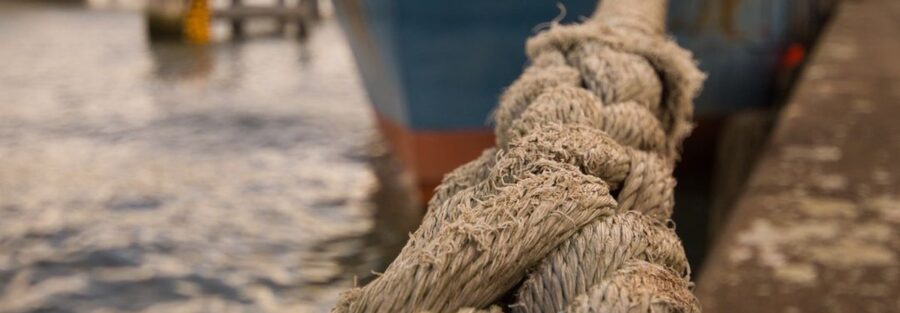
Mona Manx. The port prohibited ship-running manoeuvres.
The master and pilot were never given that procedure.
Mona Manx. Puerto Ventanas. 26 August 2021.
The bulk carrier was asked to move 30m astern. Its engine was set to dead slow astern, and the vessel eventually reached 0.5 knots.
Mooring lines were already deployed.
The aft spring became trapped between the vessel and the berth, probably near a fender.
Then it released.
A working length of about 29m recoiled approximately 9m upwards in less than one second.
The second officer was in its path.
The line struck him under the chin and threw him against the accommodation ladder. His injuries were unsurvivable.
The immediate finding is clear.
He was standing in the danger zone of a tensioned line.
The investigation considered it highly probable that he had moved forward to improve his view of that line.
That finding matters.
But it does not complete the analysis.
The officer was supervising an operation whose risk had changed. The vessel was no longer completing a standard berthing sequence. It was moving astern under its own power with mooring lines deployed.
That manoeuvre received no toolbox talk.
It was not risk assessed by the vessel or the port operator.
The port already had a control. Its mooring procedure prohibited ship-running manoeuvres.
But the procedure was not provided to the master or pilot. It was not discussed during the master/pilot exchange.
The Code of Safe Working Practices also had a boundary. Its mooring guidance did not include line entrapment or vertical recoil.
So the deck team faced a hazard that sat between several controls.
The terminal rule did not reach the bridge.
The operational change did not trigger a shared risk review.
The published guidance did not describe the recoil geometry that developed.
Telling people to remain outside danger zones is necessary. It is not enough when someone must move closer to understand what the line is doing.
Management assurance must test the point where a routine operation changes.
What requires the bridge to stop and re-brief after the planned vessel movement changes?
Who confirms that port restrictions have reached the master and pilot?
Can the person supervising the mooring station see the complete lead of every tensioned line from a safe position?
And if a line becomes trapped, does everybody know who stops the movement before anyone approaches it?
If a port requests an unplanned movement after mooring lines are deployed, what in your SMS prevents the engine from moving until ship and shore reassess the risk together?
#MaritimeSafety #MarineAccidentInvestigation #SafetyManagement #RiskAssessment #ShipOperations
