
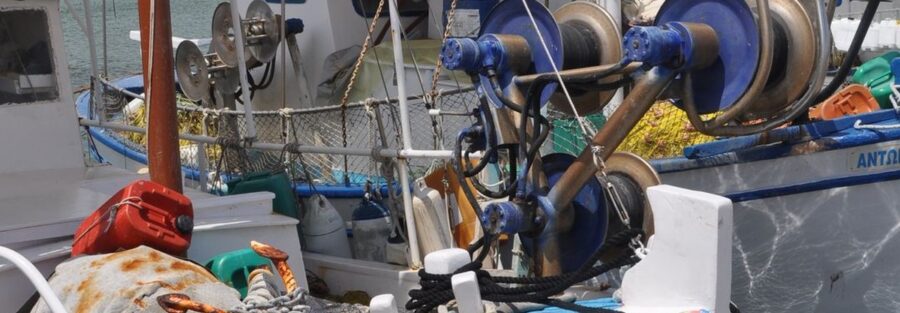
Kingfisher. The PFD inflated automatically.
The deckhand was still pulled underwater by the fishing gear attached through its recovery becket.
At 1508, on the fishing vessel Kingfisher, a toggle passed through two openings.
The eye in the creel's leg rope.
And the loose becket hanging from the deckhand's PFD.
The sinking creels pulled him underwater.
The crew recovered him within seven minutes. He could not be revived.
The recorded cause of death was drowning.
The obvious response would be to blame defective PPE.
But the PFD inflated.
The becket was also there for a reason. It was required by the relevant ISO standard and intended to help recover a person from the water.
A recovery feature had become a snagging point.
Heavy use had degraded the Velcro securing the PFD stole. On some units, the becket could release and hang loose.
The blue toggle design made the exposure worse. Its long, slim and pointed shape made it more likely to catch.
This hazard was not entirely hidden.
Some crew members had already cut the becket from their PFDs.
They had found a practical response to a real deck problem. But the modification was not known by everyone on board or by the vessel owner.
None of the crew understood what the becket was designed to do.
That left two uncontrolled risks.
Keep the becket, and it could snag.
Remove it, and the PFD no longer retained the recovery feature required by its design standard.
The vessel's risk assessments required crew to report snagging hazards.
Yet they did not identify any specific risk of fishing gear snagging a PFD. They were also not reviewed and updated as the operation and hazards changed.
So the formal control waited for a report.
The crew response remained local.
One person adapted the equipment. Another person continued wearing it unchanged. Management had no reliable feedback that the PPE and fishing gear had become incompatible in service.
This is where PPE assurance often stops too early.
Approved equipment is selected. A record is signed. Wearing it becomes mandatory.
But compatibility is not fixed at the purchase date.
Velcro wears. Components loosen. Fishing gear changes. Crew members find workarounds before the risk assessment catches up.
For a DPA or vessel owner, checking whether PPE is worn is only the first control.
Put the worn equipment into the real task.
Watch where it can catch.
Ask what has been cut, tied back or modified. Then trace how that information reaches the person responsible for reviewing the risk assessment.
If a crew member quietly modifies PPE to stay safe, what turns that warning into a vessel-wide control?
#MaritimeSafety #FishingVessels #ManOverboard #PPE #RiskAssessment
