
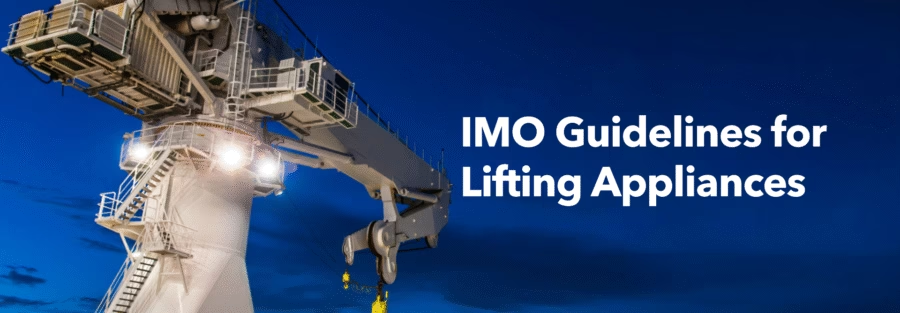
Lifting Appliances Under SOLAS 2026: What Every Shipowner Should Know
Why Lifting Appliance Safety Can No Longer Be Overlooked
At sea, lifting appliances—like cranes, davits, and winches—are used daily to handle cargo, fuel, provisions, and essential operational tasks. Their routine nature, however, masks a harsh reality: lifting operations are among the top causes of workplace injuries and fatalities. Combine that with the challenges of a corrosive maritime environment, and the stakes are even higher—both for human lives and for vessels’ operational integrity.
To address this, the International Maritime Organization (IMO) has introduced a game‑changer: SOLAS Regulation II‑1/3‑13, adopted via Resolution MSC.532(107), which officially takes effect on 1 January 2026. This crucial amendment brings comprehensive, mandatory safety standards for onboard lifting appliances and anchor‑handling winches into the SOLAS convention.
From Fragmented Rules to Unified Global Standards
Previously, lifting appliances were regulated inconsistently under a mix of flag-state rules, classification society notations, and the ILO Convention 152, leading to variable safety standards worldwide. With this amendment, the IMO has created a rigorous, unified framework covering the entire lifecycle of these devices—from design and installation to testing, documentation, and maintenance.
Perhaps most significantly, compliance is now directly tied to a vessel’s Cargo Ship Safety Construction Certificate—without which a ship cannot legally trade. Lifting appliance safety has moved from being optional to being a legal imperative.

What Counts as a “Lifting Appliance”?
SOLAS II‑1/3‑13 encompasses most permanently installed lifting systems on board and their loose gear. This includes:
- Cargo, engine-room, stores, and hose-handling cranes
- Davits for deploying tenders, workboats, or rescue boats (outside LSA systems)
- Personnel cranes
- Hatch-cover lifters and moveable decks/ramps
- Anchor-handling winches (with specific guidelines under MSC.1/Circ.1662)
Exclusions apply, such as:
- MODU and offshore construction vessel lifting gear already falling under different standards
- LSA-launching appliances regulated by the LSA Code
- Integrated hatch opening systems (non-lifting)
What About Small Gear under 1,000 kg SWL?
Appliances with a Safe Working Load below 1,000 kg are covered—though how strictly the regulation applies depends on the flag state. Some flags (like the UK and Singapore) enforce full compliance. Others (e.g., Liberia, Türkiye, Marshall Islands) allow exemptions from design approval but require that such small gear be included in the vessel’s Safety Management System (SMS) via risk assessments, maintenance, and crew training.
If your fleet sails under various flags, it’s critical to understand each administration’s interpretation to avoid surprises.
Two Paths to Compliance: New vs. Existing Installations
New Appliances (installed from 1 Jan 2026 onward):
- Must undergo full approval: design review, material checks, fabrication surveys, component certification, plus a final load test and examination.
- Arrive with a complete certification package.
Existing Appliances (installed before 1 Jan 2026):
- Must be tested and examined before—or at—the first Cargo Ship Safety Construction Certificate renewal survey on or after 1 Jan 2026.
- If already certified under ILO 152 or class schemes, compliance is grandfathered (with transition into SOLAS scheme).
- If not certified, a “Factual Statement” can be issued post-testing by the class society.
- For gear with unknown SWL, owners can nominate a SWL, subject to surveyor approval.
What Comes Next: Ongoing Safety Obligations from 2026 Onward
All covered appliances—regardless of age—must adhere to:
- Annual thorough examinations by a qualified person
- Five-yearly load testing
- Testing after major repairs or modifications
- Full integration into the vessel’s SMS and Planned Maintenance System (PMS)
- Maintenance of a comprehensive Register of Lifting Appliances and Cargo Gear on board
- Permanent SWL markings and, for cranes, visible load charts
- Operator competence training and formal Master authorization
Your 2025 Action Plan
- Begin auditing all lifting appliances across your fleet—identify new vs. existing equipment.
- Confirm certification status and SWL documentation with your class.
- Engage DB Maritime for a proactive pre-inspection audit.
- Address any compliance gaps before your vessel’s renewal survey.
- Revise your SMS and PMS to embed annual checks, load tests, training, and record-keeping.
- Keep all documentation, certificates, and test results updated and available on board.
Final Thoughts: Elevating Safety Together
SOLAS II-1/3-13 marks a new chapter in maritime safety, elevating lifting appliances from operational tools to safety-critical components. Achieving compliance requires strategic planning—a shift from reactive fixes to proactive safety management.
With the expertise and precision of DB Maritime’s auditing services, your fleet can confidently navigate the compliance timeline, avoid detentions, and ultimately protect both crew and cargo. The 2026 deadline is approaching—let’s make sure you’re fully prepared.
How DB Maritime Auditing & Pre-Inspection Services Support Your Compliance
DB Maritime, based in Spain and operating globally, specializes in pre-inspections and audits—a vital step in ensuring readiness before official vetting such as SIRE, CDI, or PSC inspections. Their audits pinpoint hidden deficiencies and compliance gaps, so shipowners can address them proactively, avoiding costly delays and trade disruptions.
Here’s how DB Maritime can help you meet the new SOLAS requirements:
- Pre‑Inspection & Audits: Identify potential non-conformities early—covering lifting appliances, documentation, operator training, SWL markings, and SMS integration.
- Maritime Consulting: DB Maritime provides customized support to enhance safety, compliance, and operational efficiency across your fleet
- SMS & Documentation Readiness: Our team helps ensure your register, PMS, and operational manuals are up to new standards ahead of surveys.
Working with DB Maritime means you’re not just reacting—you’re leading.
Our audits help ensure you’re ahead of inspectors and aligned with SOLAS’s new safety ethos from day one.
