
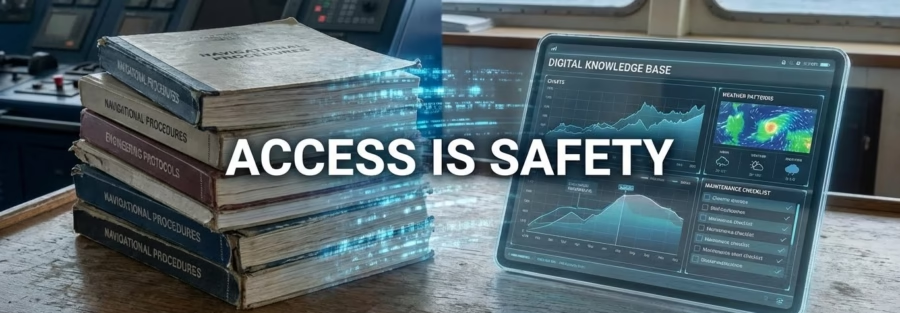
How Maritime Companies Can Safely Use LLMs Onboard – and Why They Should
(Article available on Linkedin)
Implementing Large Language Models in Maritime Industry.
From Digitalization to Cognitive Support
The maritime industry has spent the last two decades digitizing processes: PMS systems, electronic logs, e-SMS, planned maintenance software, and compliance databases.
Yet most ships today still suffer from the same operational reality:
-
Critical knowledge is buried in thousands of PDF manuals
-
Procedures exist, but are hard to retrieve under pressure
-
Experience lives in people’s heads — and leaves with crew rotation
-
Safety decisions are made with incomplete or delayed information
Large Language Models (LLMs) represent the next step — not automation, but cognitive assistance.
When implemented correctly, LLMs do not replace officers, engineers, or DPAs. They reduce friction between people and information.
This article explains:
-
How LLMs can be deployed onboard ships
-
What concrete benefits they bring to operations, safety, and compliance
-
How tools similar to Google NotebookLM can be adapted to maritime use
-
Practical examples of ship-ready prompts
What an LLM Actually Is (and What It Is Not)
A Large Language Model is not a chatbot that “knows everything”.
In maritime applications, a safe LLM is:
-
Source-grounded – answers only from approved documents
-
Context-aware – understands operational language and intent
-
Assistive – supports decisions, never replaces them
-
Auditable – every answer can be traced back to a source
Think of it as a senior officer who has read every manual, circular, and procedure — instantly.
Why LLMs Make Sense Onboard Ships
1. Ships Are Information-Dense Environments
A single vessel may carry:
-
SMS procedures
-
OEM manuals (engine, pumps, automation, navigation)
-
Class rules
-
Flag circulars
-
Vetting observations
-
Incident reports
-
Port-specific requirements
An LLM allows crew to ask questions instead of searching documents.
Example:
“What does our SMS require before enclosed space entry when oxygen is below 20.8%?”
Instead of flipping pages, the system responds with:
-
The exact procedure
-
The conditions
-
The required controls
-
The source reference
2. Crew Experience Is Declining (and Rotating Faster)
Modern ships face:
-
Shorter contracts
-
Faster promotions
-
Less mentoring time
An onboard LLM becomes a virtual chief engineer / senior mate, available 24/7.
It does not improvise. It reminds.
3. Safety Depends on Access, Not Just Procedures
Many accidents happen not because procedures don’t exist, but because:
-
They are not found
-
They are misunderstood
-
They are remembered incorrectly under stress
LLMs shorten the distance between risk and guidance.
Architecture: How to Deploy LLMs on Ships
1. Source-Grounded Knowledge Base (RAG)
The core architecture used in maritime LLM deployments is RAG – Retrieval Augmented Generation.
How it works:
-
Approved documents are uploaded (manuals, SMS, reports)
-
They are indexed semantically
-
When a user asks a question:
This prevents hallucination and ensures compliance.
2. Notebook-Style LLMs (Google NotebookLM Model)
Tools similar to Google NotebookLM are ideal for maritime industry.
They allow:
-
Uploading PDFs, Word files, spreadsheets
-
Asking complex, contextual questions
-
Summarizing, comparing, and extracting procedures
-
Seeing which document the answer came from
For maritime companies, this model works well for:
-
Technical superintendents
-
DPAs
-
Incident investigations
-
Dry-dock preparation
-
Vetting readiness reviews
3. Onboard vs Cloud: The Connectivity Reality
Ships operate with:
-
Intermittent internet
-
Bandwidth limitations
-
Cybersecurity constraints
Recommended approach: Hybrid
-
Onboard (Edge) LLM
-
Shore-based Cloud LLM
This ensures operational continuity at sea.
Key Operational Benefits
1. Faster Decision Support During Abnormal Situations
Instead of:
“Where is that procedure…?”
Crew asks:
“What are the immediate actions after blackout during maneuvering?”
The system responds with:
-
Step-by-step actions
-
Role responsibilities
-
SMS references
Time saved = risk reduced.
2. Stronger Compliance Without More Paperwork
LLMs do not add procedures. They make existing ones usable.
This improves:
-
ISM compliance
-
SIRE 2.0 preparedness
-
PSC inspection readiness
-
Internal audit quality
3. Knowledge Retention Across Crew Changes
LLMs can include:
-
Past defect reports
-
Near-miss analyses
-
Superintendent remarks
-
Lessons learned
New crew can ask:
“What recurring problems has this auxiliary boiler had?”
And get an institutional memory — not hearsay.
4. Support for DPAs and Shore Management
For DPAs, LLMs enable:
-
Pattern analysis across incident reports
-
Faster root cause preparation
-
Better safety communication drafts
-
Early identification of systemic issues
Practical Prompt Examples (Maritime-Ready)
Example 1 – Engine Room Troubleshooting
“Based on the MAN B&W main engine manual and past defect reports, what are the likely causes of high exhaust temperature on cylinder 4, and what checks are required before reducing load?”
Example 2 – SMS Compliance
“What does our SMS require before hot work in a hazardous area, and which risk assessment form must be completed?”
Example 3 – PSC Preparation
“Summarize the most common deficiencies for bulk carriers in Rotterdam PSC inspections and cross-check them with our last internal audit findings.”
Example 4 – Incident Review
“Analyze the last three enclosed space near-miss reports and identify common contributing factors related to human behavior.”
Example 5 – Environmental Compliance
“Under MARPOL Annex I and our company procedures, is bilge water discharge permitted at our current position (Antwerp Anchorage), and what ORB entry is required?”
Safety, Trust, and Human-in-the-Loop
LLMs onboard ships must follow one rule:
AI may advise. Humans decide.
Best practice includes:
-
Mandatory source citation
-
Confidence thresholds (the model can say “I don’t know”)
-
Clear labeling as decision support
-
Training crews to challenge AI outputs
This aligns with modern safety culture — not blind automation.
Cybersecurity and Data Protection
Maritime LLM deployments must ensure:
-
No uncontrolled data leakage
-
Role-based access (crew vs shore)
-
No training on confidential data without consent
-
Compliance with GDPR and flag requirements
Private, isolated knowledge bases are essential.
From Paper Compliance to Cognitive Safety
LLMs will not make ships autonomous.
They will make people better informed, calmer, and faster under pressure.
For maritime companies, the question is no longer if LLMs will be used — but who will use them responsibly first.
Those who treat LLMs as:
-
A safety multiplier
-
A knowledge stabilizer
-
A human-centric tool
will gain not just efficiency — but operational resilience.
From Concept to Real Implementation
Beyond writing and speaking about LLMs, I am actively involved in implementing these solutions in real maritime organizations — both ashore and onboard.
This includes:
-
designing ship-safe LLM architectures (SMS- and compliance-aligned),
-
building document-grounded knowledge systems for crews and DPAs,
-
integrating LLMs with existing SMS, manuals, and incident databases,
-
and training management and crews on how to use AI responsibly as decision support.
These are not experimental pilots or “innovation showcases”. They are practical, auditable systems already delivering value.
From a management perspective, this is one of the few areas today where real, measurable savings are still achievable — not by cutting safety, but by:
-
reducing time lost searching for information,
-
preventing repeat defects and incidents,
-
improving audit and vetting preparedness,
-
and lowering the hidden cost of inefficiency, rework, and human error.
Many companies try to find savings in crewing, maintenance, or compliance — areas where margins are already thin and risks are high. LLM-based decision support is different: it reduces waste without reducing capability.
If you would like to see practical examples of how such systems work in real maritime settings, I am happy to demonstrate concrete use cases and discuss how they can be adapted to your fleet, SMS, and operational reality.
You are welcome to reach out directly.
