
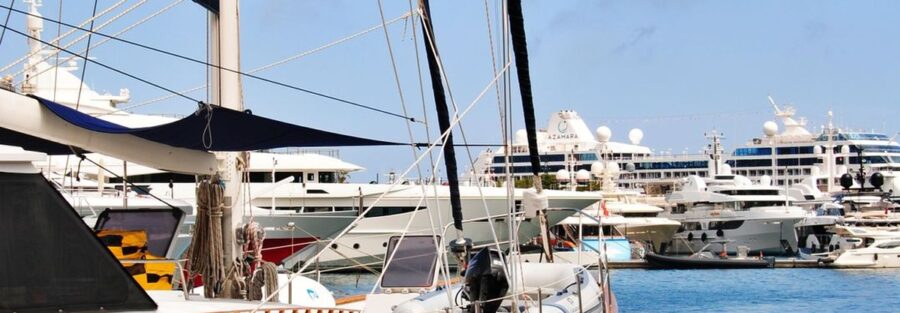
Foundering of the. The stability booklet covered three operating conditions.
It did not identify the vulnerability of the condition Bayesian was actually in.
Bayesian was anchored off Porticello.
No sails were set.
The centreboard was raised.
At 0406, the yacht heeled 90° to starboard.
It took less than 15 seconds.
The wind had suddenly increased beyond 70 knots as the skipper prepared to bring the yacht into wind.
Extreme weather is the obvious explanation.
The report considers a mesocyclonic storm highly likely. Local winds associated with waterspouts or downdrafts could have reached hurricane force.
But the stability analysis adds another layer.
Bayesian’s 72-metre mast produced half the total wind heeling moment when the wind was directly on the beam.
In the modelled motoring condition, a beam gust above 63.4 knots would probably capsize the yacht.
That vulnerability was not identified in the stability information carried on board.
The owner did not know it.
The crew did not know it.
This matters more than another argument about whether somebody reacted quickly enough.
The skipper had set a clear intervention point. Wake him above 20 knots or if the anchor started dragging.
By around 0355, the wind had reached 30 knots. The yacht was listing and the watchkeeper suspected dragging.
By around 0400, the skipper was awake.
Generators were running. Steering and propeller systems were being prepared. The crew were responding to an operational emergency.
They were doing so without knowing the yacht’s calculated vulnerability in its actual configuration.
The weakness sat inside the information itself.
The documented conditions required the centreboard to be lowered. Yet the booklet contained no maximum steady heel curves for motoring with the centreboard raised and no sails set.
A stability document can be present, approved and familiar.
That does not mean it answers the question facing the Master at anchor.
For management, the assurance test is practical.
List the configurations the vessel actually uses: sailing, motoring, anchored, reduced consumables, sails lowered, centreboard or appendages raised.
Then check whether the stability information gives the Master a usable limit for each one.
Not only a calculation.
A limit connected to an operational decision.
This is an interim report based on limited verified evidence. It does not justify a simple verdict about one action or one person.
It does justify checking whether the crew can recognise when their normal operating condition has crossed into a condition the vessel cannot survive.
Does your stability information describe the vessel as operated, or only the conditions selected for calculation?
#MaritimeSafety #MarineAccidentInvestigation #Stability #ShipOperations #LessonsLearned
