
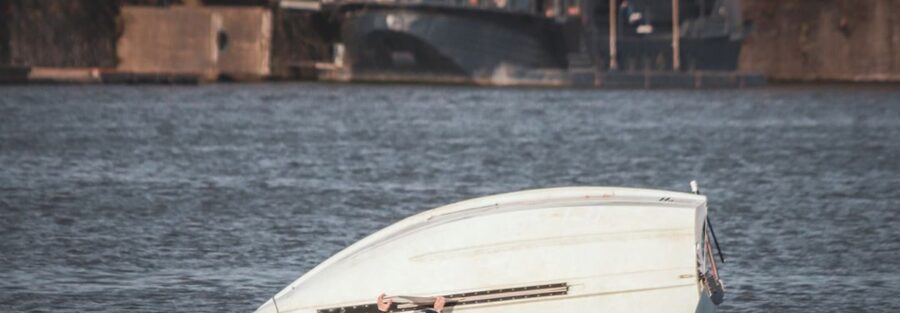
Njord. The stability book allowed no more than 4 tonnes of fish in the hopper.
Njord had about 10 tonnes there when it capsized.
On 6 March 2022, the 26.56m stern trawler was processing a large haul 150 nautical miles north-east of Peterhead.
All eight crew members entered the water.
One drowned.
Attention naturally goes to the size of the catch.
But the haul acted on a vessel already operating outside several assumptions used in its stability book.
Modifications completed in 2021 had reduced Njord’s transverse stability margin.
The MCA had not been formally informed.
No naval architect had calculated their effect on stability.
The book’s operating condition assumed 25 tonnes of ice. About 12.5 tonnes remained on board.
It limited fish in the hopper to 4 tonnes and required it to be moved below as soon as possible.
The hopper was full. Approximately 10 tonnes.
Then the catch added another force.
The net was secured to the starboard trawl winch. Its weight acted on a handrail high on the vessel’s starboard side.
The heel increased.
A drain valve through the weathertight bulkhead had been left open.
With that valve open, the assessed downflooding angle fell from 46° to around 17°.
The assessed condition and the operating condition had separated.
That separation was not only a naval architecture issue.
It was an operational control issue.
A stability book can state a limit.
It cannot weigh the hopper.
It cannot compare the remaining ice, catch distribution and deck load with the approved condition.
It cannot stop hauling when the assumptions no longer hold.
People must do that.
And management must define how they know it is being done.
Who estimates the weight in the hopper?
What tells the skipper that the loading condition has crossed a limit?
Who reviews the stability basis after modifications?
What requires the operation to stop before heel becomes the warning?
The report assessed that Njord likely would not have capsized if the drain valve had been closed at sea.
It also concluded that operation within the stability book’s assumptions would almost certainly have prevented the capsize.
That is the gap between carrying a stability book and managing stability.
For a DPA or vessel manager, checking that the approved book is on board is only the start.
Take every operational assumption from it.
Assign an owner.
Define what must be measured.
Set the point where fishing stops.
Then verify that the decision still works during an exceptional haul.
Where does your system turn stability-book assumptions into limits that someone measures, owns and can stop work for?
#MaritimeSafety #MarineAccidentInvestigation #FishingVessels #Stability #Flooding
