
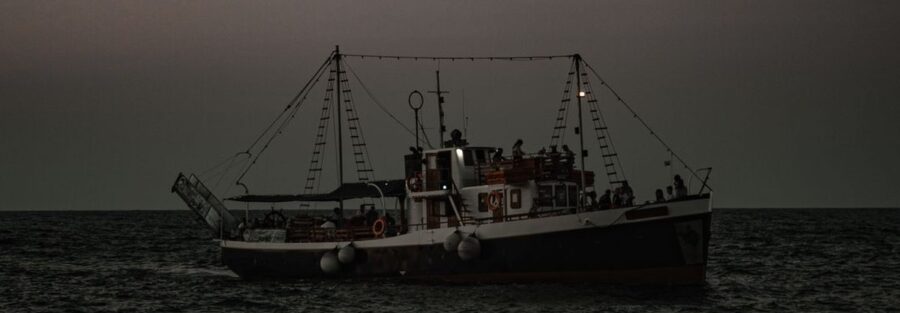
Capsize and foundering. Odyssey met every intact stability requirement.
Four cubic metres of water on the shelter deck could still remove that stability.
On 29 October 2024, the prawn trawler capsized in the North Sea, about 133 nautical miles south-east of Peterhead.
All six crew members escaped uninjured.
The immediate explanation appears simple.
Two high-capacity deck wash pumps were left running. They discharged onto an unattended weathertight shelter deck.
Their combined theoretical capacity was 2,100 litres per minute.
The deck had two tonnage valves for drainage. One probably became blocked.
Water kept entering. It could no longer leave fast enough.
The investigation calculated that stability could be lost within two minutes. The observed flooding level could be reached within six.
Odyssey capsized after approximately sixteen minutes.
The crew did not initially recognise the warning.
They interpreted the developing starboard list as a normal effect of recovering the fishing gear.
That reaction makes operational sense.
The vessel was already in a vulnerable phase. Catch was in the hopper. Fishing gear was suspended. Movement and list were expected.
The flooding looked like part of the job until it was too late.
But this was not only a blocked drain.
The flooding risk assessments and drills did not address wash water accumulating on the shelter deck.
The vessel prepared for flooding. It did not identify its own wash system as the source.
The pump switches were in the engine room. There was no emergency or remote stop.
So the control depended on several assumptions holding together.
The tonnage valves would remain clear.
Someone would notice the water.
The list would be recognised as abnormal.
The pumps could then be reached and stopped in time.
Normal work had already weakened each assumption.
The deck was unattended. The fishing operation produced expected movement. A single obstructed valve changed the drainage balance. The available response time was measured in minutes.
This is where intact stability compliance can mislead management.
The approved condition is not every operating condition.
A risk assessment must also test what the vessel itself can introduce: deck wash water, internal transfers, open-ended lines and machinery left running outside immediate observation.
For a DPA or vessel manager, the practical test is physical.
Run every fixed water source.
Restrict one drain.
Check where the water collects.
Establish who can see it developing.
Then confirm how the inflow can be stopped without entering the affected space.
Odyssey had drainage, stability information and flooding drills.
The missing control was the connection between them.
Does your flooding assessment cover water generated by the vessel itself, or only water expected to come from the sea?
#MaritimeSafety #MarineAccidentInvestigation #SafetyManagement #RiskAssessment #FishingVessels
